


Buying large land tracts near Penn State Mont Alto requires confirming the parcel's municipality, zoning district, permitted uses, access, and utility availability before making any development assumptions. Franklin County's land-use authority rests with individual townships and boroughs, so two adjacent parcels can carry completely different rules.
What should buyers know before purchasing large land tracts near Penn State Mont Alto?
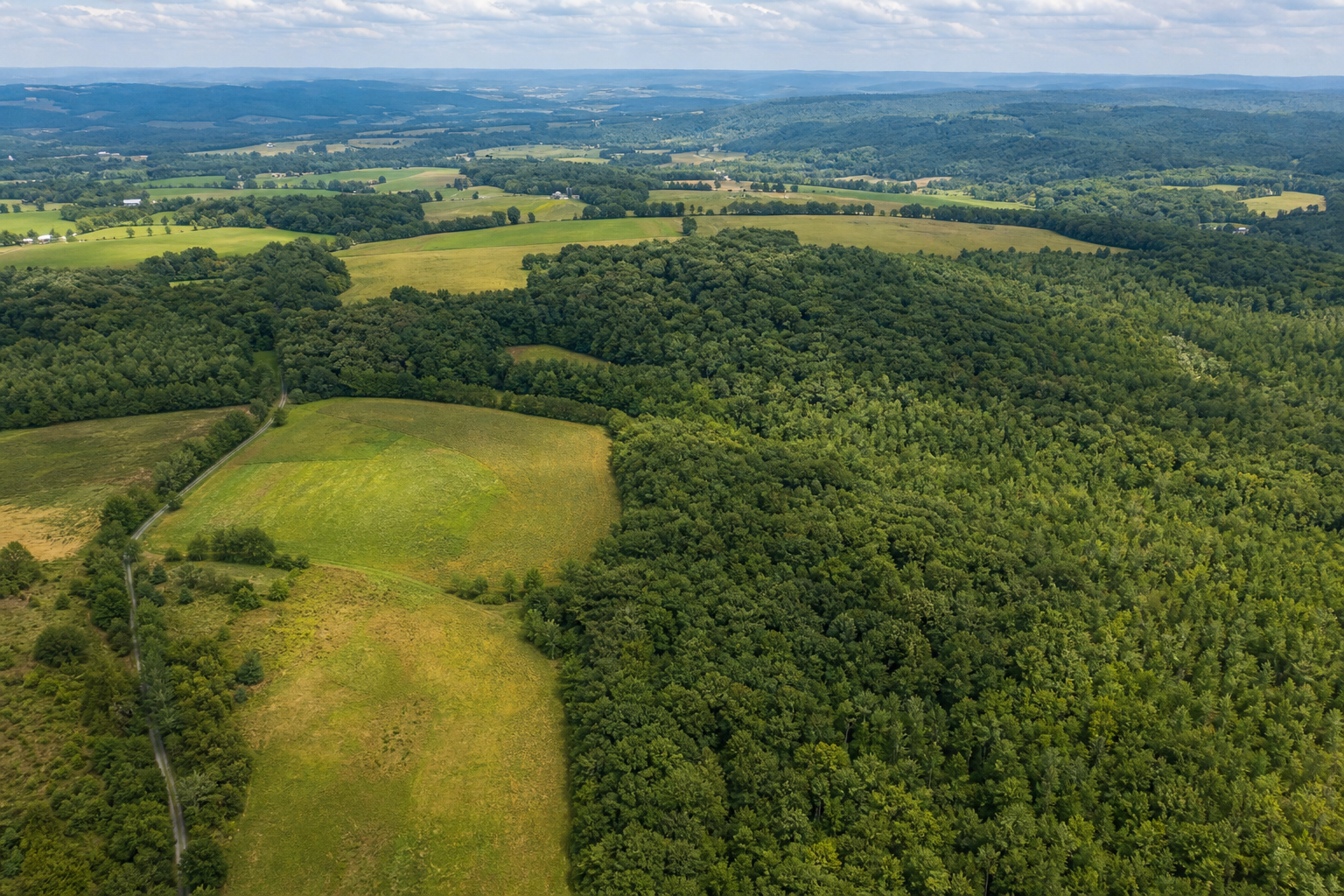
Large land tracts near Penn State Mont Alto sit in one of Franklin County's most scenic rural corridors, but the due-diligence process is more layered than a standard home purchase. The parcel's municipality controls zoning, permitted uses, and subdivision rules, so the first step is confirming exactly which jurisdiction the land falls in before assuming what you can build, divide, or operate on it.
Key Takeaways
-
Land near Penn State Mont Alto usually falls in a surrounding township, and each one sets its own zoning, setbacks, and permitted uses independently.
-
Franklin County recorded 133 subdivision or lot-line-adjustment plans countywide in 2025, according to the Franklin County 2025 Annual Report, reflecting active land-division activity across the region.
-
Buying a large tract as one parcel does not trigger subdivision review, but any future division, new road, or multiple homesites can require formal municipal and county planning approval.
-
Penn State Mont Alto's campus covers approximately 103 acres, per the Franklin County Greenway and Open Space Plan, making it a useful geographic anchor for understanding what surrounds it, not a guide to how nearby private land is zoned or developed.
-
Physical constraints including streams, wetlands, steep slopes, and floodplain areas can reduce the buildable portion of a parcel significantly, regardless of total deeded acreage.
Why does the municipality matter so much when buying land near Penn State Mont Alto?
This is one of the first questions I ask a buyer who calls me about acreage. A parcel's address might say Mont Alto, but it could sit inside of a Borough, Quincy Township, Washington Township, or another jurisdiction entirely. Each one operates under its own zoning ordinance and its own subdivision and land-development ordinance (SALDO).
In Franklin County, land-use authority rests with individual municipalities, not the county. The Franklin County Planning Commission reviews plans for regional impact and provides comment, but it does not replace municipal approval. That means two parcels sitting a quarter mile apart can have completely different rules for what you can build, how close to a property line you can build it, and whether you need a hearing before you can do anything at all.
The practical move is to pull the parcel's tax record, identify the municipality, and then go directly to that municipality's zoning map and ordinance. That document tells you the zoning district, the permitted uses by right, and what requires conditional-use or special-exception approval. I walk my clients through this before we ever put an offer together, because a tract that looks perfect on paper can have a zoning designation that rules out the intended use entirely.
What kinds of uses typically come up for large tracts in this area?
The buyers I work with near Mont Alto have a wide range of goals. Some want a private homesite with room to farm or keep animals. Others are looking at hunting or recreational land. A smaller group is exploring event venues, agritourism operations, or long-term investment in raw acreage. Each of those uses triggers different questions under the local ordinance, and none of them should be assumed without a written confirmation from the municipality.
If you are considering a use beyond a standard single-family home, ask the municipality directly whether it requires a conditional-use hearing, a special exception from the zoning hearing board, or a variance. Get that answer in writing before you close. I've known people who discovered after settlement that the use they planned required a hearing they didn't know about, and that is an expensive lesson.
For more context on what's driving demand for rural acreage across the broader region, my post on why Franklin and Fulton Counties are attracting buyers looking for large rural tracts covers the landscape well.
What due-diligence steps apply specifically to large land tracts near Penn State Mont Alto?
A large-tract purchase has a longer due-diligence checklist than a residential home, and the consequences of skipping a step are proportionally larger. Here is the sequence I walk my land buyers through.
Zoning and permitted-use confirmation
Identify the parcel's municipality and zoning district first. Obtain the current zoning ordinance and read the permitted-use table for that district. Then confirm with the municipal zoning officer whether your intended use is permitted by right, requires approval, or is not permitted at all. Do not rely on a seller's representation or a listing description for this, because zoning can change and descriptions can be wrong.
Subdivision and land-development review
Buying the entire parcel as a single tract does not trigger subdivision review. But if you plan to divide it later, create a new lot, build a road, or develop multiple homesites, you are likely looking at formal review. local municipality's subdivision ordinances define subdivision broadly enough to capture divisions made for future transfer, building, or lot development, and it give them approval authority with planning commission reviewing plans and the Franklin County Planning Commission receiving them for review and report. If your vision for the tract involves any future division, build out that question into your due diligence now, not after you own it.
Access, road frontage, and title review
Legal road frontage is not guaranteed just because a parcel appears to touch a road on a map. Before closing, confirm that the parcel has legal access to a public road, review recorded easements and rights-of-way, and check for shared drives, encroachments, or mineral and timber reservations in the chain of title. A survey and a full title search are not optional on a large tract. They are the documents that tell you what you actually own and how you can reach it.
Utilities and on-lot sewage
Rural parcels near Mont Alto are not guaranteed public water or public sewer service. Treat utility availability as parcel-specific and get written confirmation from the relevant utility or authority before making any development assumptions. Where on-lot sewage is the plan, you will need a soil evaluation and a sewage permit through the local sewage enforcement officer (SEO) before you can build. Soil that won't perc for a septic system can make an otherwise attractive tract undevelopable for residential use.
Physical constraints and environmental features
Deeded acreage and usable acreage are not the same number. Rural tracts in this part of Franklin County can include streams, wetlands, steep slopes, wooded terrain, agricultural soils, and floodplain areas. Any of those features can reduce the buildable footprint significantly. A Phase 1 environmental site assessment, a wetlands delineation, and a review of FEMA flood maps are worth the cost on a large tract. The Franklin County Greenway and Open Space Plan documents the kinds of natural features present throughout the county, including areas adjacent to the Penn State Mont Alto campus, and it is a useful starting point for understanding what you may encounter.
If hunting or recreational use is part of your plan, the physical constraints I just described are often features rather than liabilities. My guide to hunting properties in South Central PA covers how to evaluate wooded and mixed-terrain tracts for that purpose.
Due-Diligence Items - Why It Matters on a Large Tract - Who to Contact:
Municipal zoning confirmation - permitted uses vary by municipality, Contact a district municipal zoning officer, Subdivision/SALDO review.
Future division or development trigger formal approvals. A boundary review confirms deeded acreage, easements, encroachments. A licensed surveyor title search reveals mineral/timber reservations, rights-of-ways, and liens.
Utility availability confirmation - Public water/sewer is not guaranteed in rural areas. Contact Municipal authority or utility provider. Sewage feasibility; (if on-lot); Soil must support a septic system before you can build; contact Local sewage enforcement officer (SEO).
Environmental and physical constraints; Wetlands, floodplain, steep slopes reduce buildable area; contact Environmental consultant, FEMA flood maps
What does the land market near Penn State Mont Alto look like right now?
Large-tract land inventory in Franklin County moves differently than the residential market, and acreage-specific data for this corridor is something you need a local agent to pull for you directly from the MLS. What I can tell you is that Franklin County recorded 133 subdivision or lot-line-adjustment plans in 2025, according to the Franklin County 2025 Annual Report, which reflects consistent activity in the land-division space across the county. That is a countywide figure, not a Mont Alto-specific one, but it confirms that land transactions are a real and active part of this market.
What drives interest in this specific corridor is the combination of proximity to Penn State Mont Alto's campus, access to South Mountain recreation, and the rural character that buyers relocating from more congested markets are specifically looking for. Penn State Mont Alto's campus itself covers approximately 103 acres, and the surrounding area offers a mix of agricultural, wooded, and mixed-terrain parcels that attract buyers with a range of goals.
For a current read on what is available, what has sold, and what the per-acre market looks like for tracts in this area, the right move is a conversation with me directly. I can pull active and sold data filtered to acreage, run a comparative analysis, and tell you whether a specific parcel is priced in line with the market. That analysis is parcel-specific and current, and it is the foundation of every land offer I help clients put together.
You can also browse current listings in my Central Pennsylvania land listings resource for a sense of what is moving across the region.
Frequently Asked Questions
What zoning district is my land in near Penn State Mont Alto?
The zoning district depends on which municipality the parcel falls in, since land near Penn State Mont Alto may be in a surrounding township, each with its own zoning map and ordinance. To confirm your parcel's district, contact the municipal zoning officer directly with the parcel's tax ID or legal description. The Franklin County Planning Department can also help you identify the correct municipality if you are unsure.
Do I need subdivision approval if I am buying the entire parcel?
Buying a large tract as a single, undivided parcel does not trigger subdivision review. Subdivision review becomes required if you later divide the parcel, create a new lot, build a road, or develop multiple homesites, because municipality ordinances define subdivision broadly to include divisions made for future transfer or building. If there is any chance you will want to divide the tract later, build that question into your due diligence before you close.
Can I build a house, farm, hunting cabin, or event venue on a large tract near Mont Alto?
Whether any of those uses is permitted depends entirely on the parcel's zoning district and the municipality's ordinance. Some uses are permitted by right, others require a conditional-use hearing or special exception, and some are not permitted at all. Confirm your intended use in writing with the municipal zoning officer before relying on the purchase for that purpose.
How do I confirm whether a rural parcel has public water, sewer, or only well and septic service?
Contact the local municipal authority or utility provider directly and ask for written confirmation of whether the parcel falls within their service area. Do not assume that proximity to a developed area means service is available, because rural tracts near Mont Alto frequently rely on private well and on-lot septic systems. If on-lot sewage is the plan, you will also need a soil evaluation through the local sewage enforcement officer before you can obtain a sewage permit.
Should I order a survey, title search, soil evaluation, or environmental review before purchasing?
On a large tract, all four of those are worth the cost. A survey confirms boundaries, easements, and road frontage; a title search reveals mineral or timber reservations, rights-of-way, and liens; a soil evaluation confirms sewage feasibility if public sewer is unavailable; and an environmental review identifies wetlands, floodplain areas, and other physical constraints that affect how much of the acreage is actually buildable. Skipping any of these on a large-tract purchase is where buyers run into expensive surprises after closing.
How can I verify legal road frontage and access before buying acreage?
A licensed surveyor can confirm whether the parcel has legal frontage on a public road and identify any easements, shared drives, or rights-of-way that affect access. A title search will reveal recorded access easements or restrictions in the chain of title. Never assume access from a map or a listing description alone, because landlocked parcels do exist and resolving an access issue after closing is costly and time-consuming.
Buying large land tracts near Penn State Mont Alto rewards buyers who do the homework upfront. The due-diligence steps I outlined above, zoning confirmation, subdivision review, survey, title, utilities, and physical constraints, are not bureaucratic formalities. They are the difference between owning land that does exactly what you need it to do and owning land that surprises you with restrictions you did not see coming.
I have spent 22 years working with buyers and sellers across Franklin County and the surrounding region, including large tracts, farms, hunting properties, and rural estates. If you are looking at acreage near Penn State Mont Alto, I can pull current inventory, run a market analysis, and walk you through the due-diligence process from start to close. Reach out to Jay today and let's talk about what you are looking for.
About Jay Starr
Jay Starr, REALTOR® and Team Leader of The Jay Starr Team at RE/MAX 1st Advantage, is a 22-year full-time real estate professional serving South-Central Pennsylvania and Central Maryland. With hundreds of homes sold, 40+ five-star reviews, and the Certified Luxury Home Marketing Specialist designation, Jay is known for expert guidance across luxury homes, large land tracts, farms, hunting properties, residential estates, and investment properties. His service area includes Franklin, Fulton, Adams, Cumberland, Bedford, and Huntingdon Counties in PA, as well as Washington County, MD. Clients consistently praise his knowledge, patience, and skill, backed by advanced marketing, seasoned negotiation, and deep local insight. Outside of real estate, Jay manages over 10 honeybee hives and harvests local honey, a hobby that reflects his commitment to stewardship, community, and the rural lifestyle many of his clients value.
RE/MAX 1st Advantage · (717) 658-0177
Equal Housing Opportunity. Jay Starr is a Licensed Real Estate Salesperson regulated by the Pennsylvania Real Estate Commission. This article is general information only and is not legal, tax, or financial advice. Confirm your specific numbers, zoning status, and transaction details with your title company, tax advisor, lender, or municipal zoning officer.