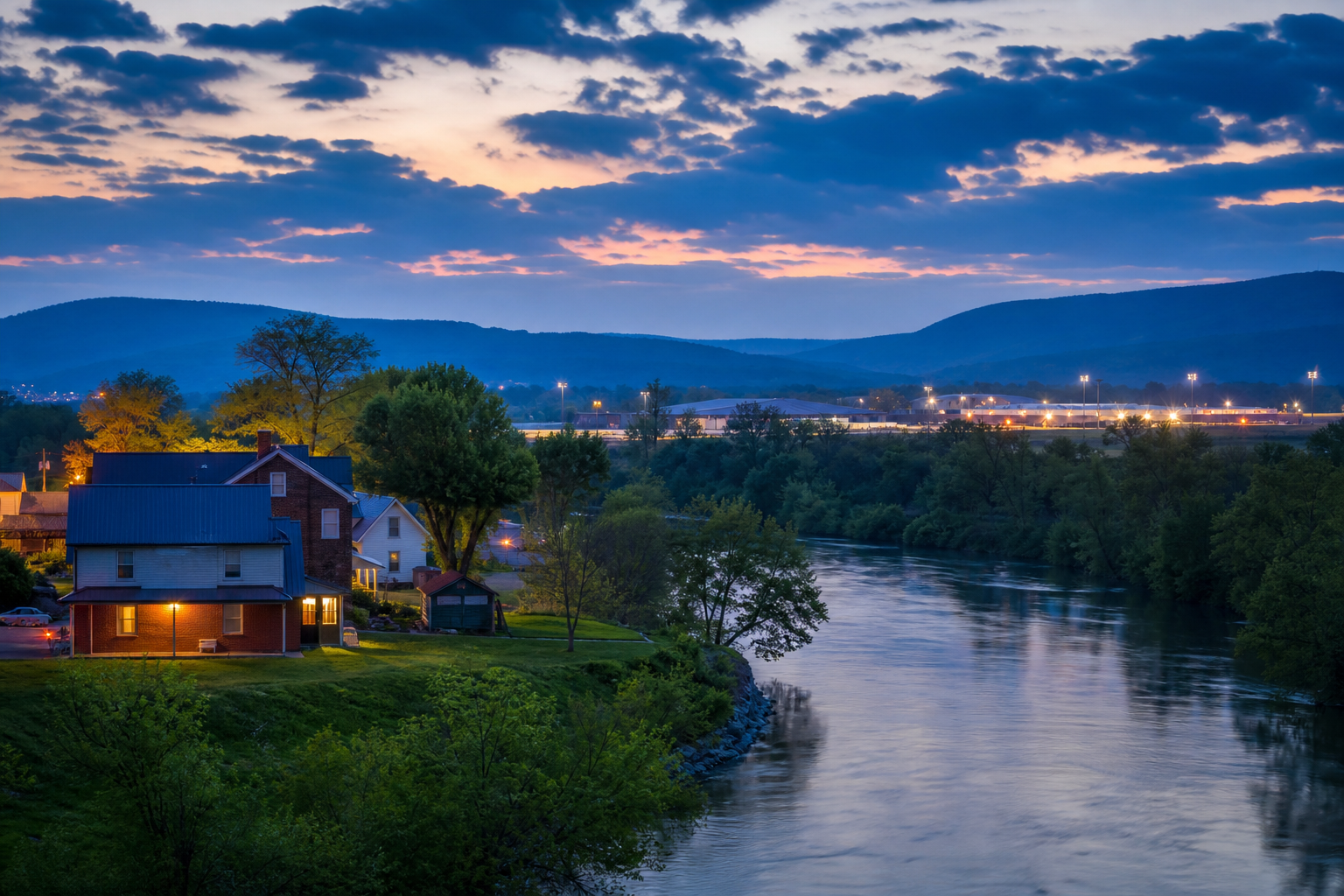
The Norfolk Southern Greencastle Intermodal Facility in Antrim Township, Franklin County, PA is a major truck-to-rail transfer point that concentrates freight demand along I-81. Industrial and warehouse properties within short drayage distance of the facility see stronger demand and lower vacancy than comparable locations farther from the hub. The effect extends south into Washington County, Maryland, where I-81 and I-70 converge, creating a contiguous logistics corridor that savvy investors are watching closely.
What the Greencastle Intermodal Hub Actually Does, and Why It Matters for Property
The Norfolk Southern Greencastle Intermodal Facility sits in Antrim Township, just south of Greencastle, directly adjacent to Interstate 81 and U.S. Route 11. Its job is straightforward: move freight between long-haul trucks and the national rail network. That means a shipper can put a container on a train in Greencastle and reach Mid-Atlantic and Northeast distribution markets without putting another long-haul truck on I-81 for hundreds of miles.
That single function has outsized consequences for the land around it.
According to the Federal Highway AdministrationI-81 is a federally designated major freight corridor carrying significant truck volumes from Tennessee to the Canadian border. Central Pennsylvania, including Franklin County, is identified as one of the highest-growth segments for distribution and warehousing along that entire stretch. When you layer an intermodal rail facility on top of that highway concentration, you get a freight magnet.
The Pennsylvania Department of Transportation explicitly references the Greencastle intermodal facility in its statewide freight planning as a critical node supporting logistics clusters in south-central Pennsylvania. That kind of official recognition matters for investors because it signals long-term infrastructure commitment, not a short-cycle trend.
The drayage radius: where the real estate story starts
In logistics real estate, "drayage" refers to the short-haul trucking leg between an intermodal yard and a nearby warehouse or distribution center. Industrial tenants and developers want to minimize that leg, typically targeting locations within 30 to 50 miles, and ideally much closer. Properties with good truck access, wide road networks, and minimal residential conflicts directly off I-81 interchanges near Greencastle fit that profile well.
National research from CBRE and JLL consistently shows that proximity to intermodal rail facilities and major interstates drives higher industrial land demand, lower vacancy rates, and more speculative development compared to non-intermodal locations. Prologis research describes a recurring pattern: new intermodal hubs catalyze logistics parks and build-to-suit distribution centers within a short drive of the facility, specifically because of drayage efficiency and access to national rail networks.
I've worked with buyers and investors in Franklin County long enough to see this play out locally. The industrial and commercial zoning districts in Antrim Township and the surrounding Greencastle area are oriented toward distribution, warehousing, and manufacturing, especially along I-81 and U.S. 11. That's not an accident. It reflects decades of local land-use planning that anticipated freight growth.
Franklin County's track record in logistics real estate
The Franklin County Area Development Corporation documents sustained growth in warehouse and distribution space along the I-81 corridor since the 2010s, with large logistics parks and regional distribution centers clustered near interchanges serving Greencastle and Chambersburg. The Pennsylvania Department of Community and Economic Development describes south-central Pennsylvania's I-81 corridor as a location where companies position distribution centers to reach major population centers within a single day's truck drive, and the Greencastle intermodal facility is repeatedly cited as an asset that enhances multimodal options and attracts industrial investment.
If you're tracking Greencastle home valuesyou'll notice that the broader economic activity generated by logistics development does filter into the residential market over time, even if the most direct effects show up first in industrial and commercial property.
The Cross-Border Opportunity: Washington County, MD and the I-81/I-70 Hub
The logistics story doesn't stop at the Pennsylvania state line. Washington County, Maryland, centered on Hagerstown, lies directly south of Greencastle along I-81, with additional connectivity via I-70. The Washington County Department of Business Development explicitly describes the county as a transportation crossroads and a growing warehouse, distribution, and manufacturing hub, leveraging both I-81 and I-70 access.
The Washington County, MD Planning Department reports continuing industrial park and distribution center development near the I-81 and I-70 interchange, closely integrated with regional freight flows that also pass through Greencastle. The county's economic development strategy explicitly leverages proximity to both rail and interstate highways, creating complementary logistics capacity to Pennsylvania's corridor and supporting a shared labor and freight shed.
What that means practically: Franklin County, PA and Washington County, MD function as a single contiguous logistics region for investors, even though they sit in two different states with two different sets of real estate rules. The freight, labor, and housing markets are tightly linked. If you're evaluating an industrial parcel near Hagerstown, what happens at the Greencastle intermodal facility is directly relevant to your underwriting, and vice versa.
That cross-border dynamic is something I navigate regularly with clients who hold or are acquiring assets on both sides of the line. The transaction process, disclosure requirements, and tax rules differ between Pennsylvania and Maryland, and getting those details wrong can cost you at closing.
What investors should focus on in zoning and infrastructure
Not every parcel near an intermodal hub is a logistics play. Here's what actually matters in due diligence around Greencastle and the broader I-81 corridor:
- Zoning classification: Industrial and commercial zoning oriented toward distribution and manufacturing is what you need. Antrim Township's zoning ordinance and land use maps identify the districts where logistics uses are permitted by right versus by special exception. Confirm this before you're under contract, not after.
- Truck access and road geometry: Wide roads, appropriate turning radii, and minimal residential adjacency matter to industrial tenants. A parcel that requires a variance or a road upgrade to accommodate 53-foot trailers is a different investment than one that's already truck-ready.
- Traffic impact requirements: The Franklin County Planning Commission requires traffic impact studies for larger logistics developments, and local planning bodies flag traffic mitigation and infrastructure improvements as factors that can affect entitlement timelines. Budget for this in your pro forma.
- Environmental and stormwater considerations: Proximity to a freight facility means potential noise, light, and traffic impacts. These can affect both entitlement and your ability to attract certain tenants. Stormwater management upgrades are commonly required during site plan review near logistics nodes.
- Drayage distance to the intermodal yard: The shorter the better. Properties directly off I-81 interchanges and within a few miles of the Greencastle facility have a structural advantage over those requiring longer truck hauls to reach the yard.
Your specific opportunity depends on your target use, your timeline, and the specific parcel. That's exactly the kind of analysis I walk investors through before they make an offer, because the numbers look very different depending on those variables.
Pennsylvania Process Details Every Investor Needs to Know
If you're buying or selling property in Franklin County or elsewhere in Pennsylvania, a few legal and process requirements are non-negotiable.
Real Estate Transfer Tax
Pennsylvania imposes a state Real Estate Transfer Tax at a statutory rate of 1% of the consideration for most real estate transfers. Municipalities and school districts can impose additional local realty transfer taxes on top of the state rate. According to the Pennsylvania Department of Revenue, who pays what portion between buyer and seller is a matter of contract, it's negotiable, not automatic. If the parties don't specify otherwise, state law provides a default allocation, but that default can be modified in your agreement of sale. Confirm the allocation in your specific contract with your attorney or closing officer, not based on what someone tells you is "standard."
Washington County, Maryland operates under a different set of transfer and recordation tax rules. If you're acquiring assets in both states, treat each transaction separately and get jurisdiction-specific guidance.
Seller's Property Disclosure Statement
Under the Pennsylvania Real Estate Seller Disclosure Law (68 Pa.C.S. §§ 7301-7314), sellers of residential real property must complete and deliver a signed property disclosure statement to the buyer before the agreement of sale is executed. The form covers structural components, roof, basement, HVAC, plumbing, electrical, water and sewage, hazardous substances, legal issues affecting title, stormwater facilities, and HOA/condo matters, among other subjects, as specified in 68 Pa.C.S. § 7304.
For investors selling a rental or small multifamily property near the Greencastle hub, this disclosure obligation applies to residential transfers. If your property is adjacent to or affected by logistics operations, traffic patterns, noise, proximity to the intermodal yard, those are material conditions worth discussing with your attorney about what requires disclosure. Under 49 Pa. Code § 35.284alicensees representing sellers must advise them of their disclosure duties and ensure the completed statement is delivered to the buyer before the agreement is signed.
Title and recording in Franklin County
Greencastle-area transactions are recorded with the Franklin County Recorder of Deeds, which applies state and applicable local realty transfer taxes and follows Pennsylvania recording requirements. A title company or settlement agent typically manages document preparation and submission as part of closing. If you hold assets in both Pennsylvania and Maryland, each state's recording and title process applies separately, there's no consolidated closing that covers both jurisdictions automatically. I tell every cross-border investor I work with to confirm their title company has experience in both states before they get to the closing table.
| Factor | Franklin County, PA (Greencastle) | Washington County, MD (Hagerstown) |
|---|---|---|
| Primary highway access | I-81, U.S. 11 | I-81, I-70 |
| Intermodal rail access | Norfolk Southern Greencastle Facility (on-corridor) | Proximate via Greencastle hub; regional rail connectivity |
| Dominant industrial use | Distribution, warehousing, manufacturing | Warehouse, distribution, manufacturing |
| State transfer tax (statutory) | 1% state + applicable local (PA Dept. of Revenue) | MD transfer and recordation taxes apply (separate rules) |
| Seller disclosure requirement | PA RESDL (68 Pa.C.S. §§ 7301-7314), residential transfers | Maryland disclosure law applies separately |
| Key due diligence item | Zoning, truck access, traffic impact study requirements | Industrial park entitlements, I-81/I-70 interchange proximity |
| Economic development body | Franklin County Area Development Corporation (FCADC) | Washington County Dept. of Business Development |
If you're also tracking the broader Franklin County market, the Chambersburg home values page gives you another data point on how the county's economic growth is filtering into residential pricing.
Frequently Asked Questions
How does the Greencastle intermodal hub change freight patterns along I-81 between Franklin County, PA and Washington County, MD?
The facility shifts a portion of long-haul truck freight onto rail at Greencastle, reducing truck miles on I-81 while concentrating freight activity around the hub itself. That concentration increases demand for nearby warehouse and distribution space in both Franklin County and Washington County, MD, which share a contiguous freight and labor shed along I-81. Regional planning agencies in both states document this cross-border logistics integration in their economic development strategies.
Is industrial land near the Greencastle intermodal facility seeing more demand than other parts of south-central Pennsylvania?
Yes, according to the Franklin County Area Development Corporation, the I-81 corridor around Greencastle and Chambersburg has seen sustained growth in warehouse and distribution space since the 2010s, with logistics parks clustering near I-81 interchanges. National research from CBRE and JLL confirms that proximity to intermodal rail facilities consistently drives higher industrial land demand and lower vacancy compared to non-intermodal locations. Parcels with direct interstate access and short drayage distance to the Greencastle yard are prioritized by logistics developers.
What should I look for in zoning and infrastructure around Greencastle and Hagerstown to benefit from I-81 logistics growth?
Confirm that the parcel carries industrial or commercial zoning that permits distribution and warehousing by right in Antrim Township or the applicable Washington County, MD zoning district. Check truck access geometry, road capacity, and whether a traffic impact study will be required during site plan review. Franklin County Planning Commission materials flag traffic mitigation and infrastructure improvements as common conditions that can extend entitlement timelines near logistics nodes, so budget for that in your timeline and pro forma.
Does proximity to the Greencastle intermodal hub affect residential property values, or is the impact mostly industrial and commercial?
The most direct effect is on industrial and commercial real estate, land values, vacancy rates, and development activity. Residential markets near logistics hubs can benefit indirectly through job creation and economic activity, but they can also face headwinds from increased truck traffic, noise, and light if the residential property is adjacent to industrial operations. The impact on any specific residential parcel depends on its location relative to the hub and the prevailing wind of local land use. I walk buyers and sellers through this distinction regularly when evaluating properties near the I-81 corridor.
How do Pennsylvania Real Estate Transfer Tax rules affect investment property purchases near the I-81 corridor compared with buying in Washington County, Maryland?
Pennsylvania imposes a state realty transfer tax at 1% of the consideration, with municipalities and school districts potentially adding local transfer taxes on top of that, according to the Pennsylvania Department of Revenue. Who pays what portion between buyer and seller is negotiable and should be specified in your agreement of sale. Maryland operates under a separate transfer and recordation tax structure with its own rates and rules. If you're acquiring assets in both states, get jurisdiction-specific guidance from your attorney or closing officer, never assume the rules from one state carry over to the other.
When selling a rental property in Franklin County, what must I disclose on the Pennsylvania Seller's Property Disclosure Statement, and do logistics-related issues like traffic and noise need to be addressed?
The Pennsylvania Real Estate Seller Disclosure Law requires disclosure of all known material defects, covering structural components, systems, hazardous substances, legal issues, stormwater facilities, and more as listed in 68 Pa.C.S. § 7304. Whether traffic patterns, noise, or proximity to the intermodal yard constitute material conditions requiring disclosure depends on the specific facts of your property and should be discussed with your attorney. The disclosure statement must be completed, signed, and delivered to the buyer before the agreement of sale is executed, not after.
The I-81 logistics corridor around Greencastle is one of the more interesting investment stories in south-central Pennsylvania right now, and the cross-border dynamic with Washington County, MD adds another layer of opportunity, and complexity. Getting the zoning, due diligence, and transaction process right from the start is what separates a good investment from an expensive lesson.
If you're evaluating land or property near the Greencastle intermodal hub or anywhere along the I-81 corridor, reach out and let's look at the specifics together. Reach out to Jay today to schedule a consultation.
Equal Housing Opportunity. Jay Starr is a Licensed Real Estate Salesperson regulated by the Pennsylvania Real Estate Commission. This article is provided for general informational purposes only and does not constitute legal, tax, or financial advice. Transaction costs, tax obligations, and legal requirements vary by property and situation, confirm your specific numbers and obligations with your attorney, tax advisor, lender, or escrow/closing officer before proceeding. Broker fees and commissions are fully negotiable and not set by law; no standard or typical rate exists.