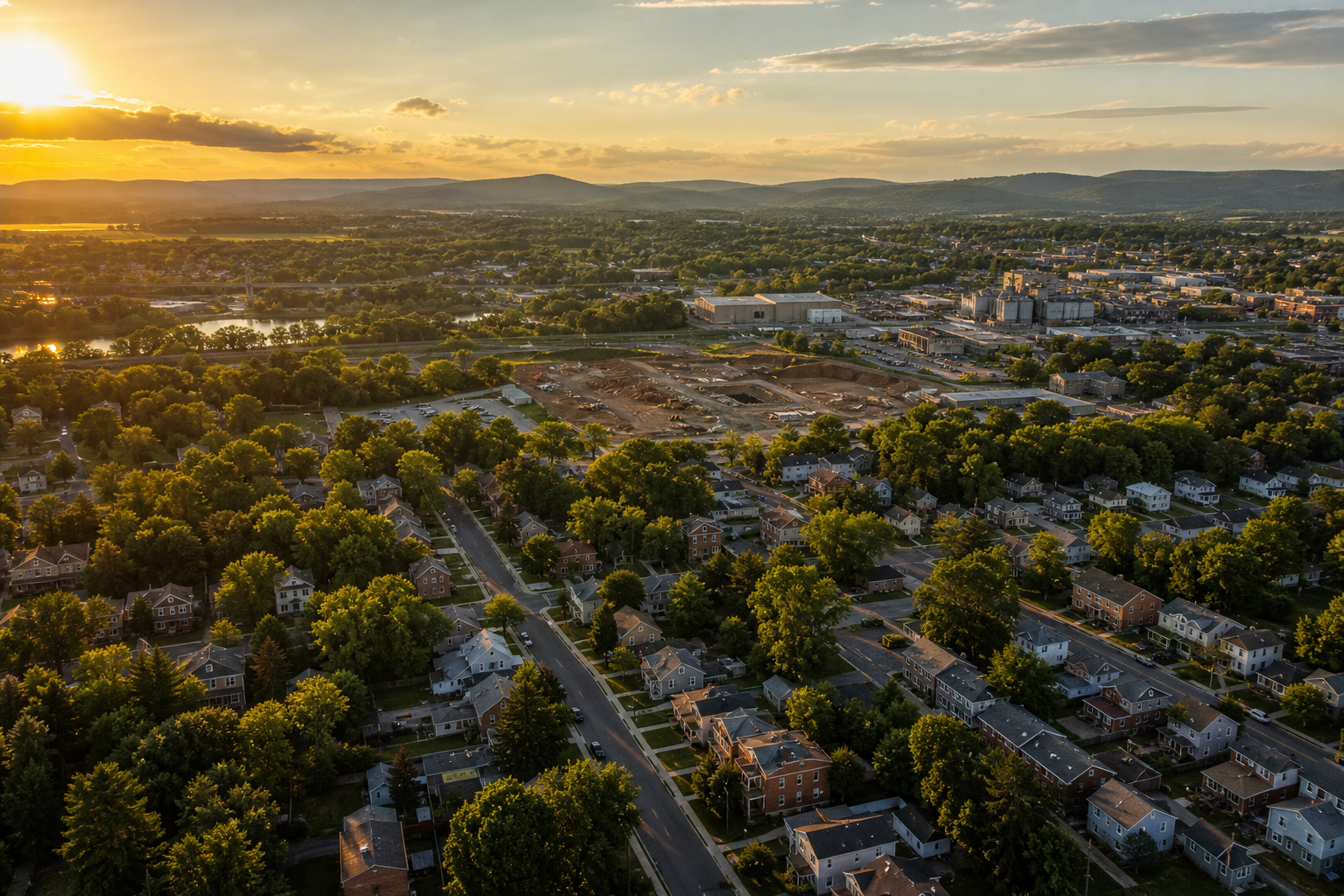
The Southgate redevelopment is converting a 13.44-acre former mall site in Chambersburg into a mixed-use residential neighborhood over a 10–20 year horizon. Infrastructure work is active in 2026, backed by a $500,000 state grant, and the project is expected to strengthen resale appeal and investor interest on Chambersburg's west side.
What does the Southgate redevelopment mean for Chambersburg real estate?
The Borough of Chambersburg is converting the 13.44-acre Southgate Shopping Center into a mixed-use residential neighborhood over a projected 10–20 year timeline. Active infrastructure work began in 2026, a $500,000 state demolition grant was awarded in July 2026, and a private developer RFP closed in mid-2025, meaning the project has moved well past the planning stage. For homeowners and investors near the Elm Street corridor, this is the kind of public-infrastructure commitment that historically precedes meaningful shifts in nearby property values and rental demand.
Key Takeaways
-
The Southgate site covers 13.44 acres on Chambersburg's west side and is planned for mixed-use residential redevelopment under the Borough's Vision 2035 Comprehensive Plan.
-
Pennsylvania awarded a $500,000 Redevelopment Assistance Capital Program grant in July 2026 specifically to demolish the former JCPenney/Big Lots building at Southgate Mall.
-
The Borough issued a developer RFP in January 2025 with a July 31, 2025 due date, signaling the transition from public infrastructure work to private build-out is actively underway.
-
Residents near Southgate should expect construction disruption, road closures, detours, and noise, through at least 2027–2028 as storm-sewer and street work progresses.
-
The full redevelopment horizon is 10–20 years, making this a long-range investment thesis, not a short-term flip story, but early-stage positioning near infrastructure improvements is historically when values begin to move.
What is actually happening at Southgate right now, and what comes next?
This is not a future plan sitting in a binder somewhere. Active work is on the ground in 2026, and it's worth understanding exactly what phase the project is in before drawing any real estate conclusions.
The Borough of Chambersburg, working alongside the Elm Street Advisory Council (ESAC), has been executing a staged approach to the Southgate site. According to the Chambersburg Vision 2035 Comprehensive Plan, the redevelopment is structured in phases: public infrastructure first, private development build-out second. That sequencing matters for anyone watching the real estate angle.
Here's where things stand as of September 2026:
-
The building formerly occupied by the Chambersburg Beauty School is being demolished to create a stormwater bio-retention area, green infrastructure that will serve the future neighborhood.
-
The existing Rail Trail and Water Street segment between W. Washington St. and W. Catherine St. is being closed to vehicles and rebuilt as a pedestrian-priority corridor.
-
A new storm sewer system is going in under Water St. and W. Washington St.
-
A cul-de-sac is being constructed on W. Liberty St. at Water St., reshaping how traffic flows through the area.
-
In July 2026, the Commonwealth of Pennsylvania awarded a $500,000 Redevelopment Assistance Capital Program (RACP) grant to fund demolition of the former JCPenney/Big Lots building, one of the largest structures on the site.
On the private-development side, the Borough issued a formal Request for Development Proposals (RFP) in January 2025, with a submission deadline of July 31, 2025. The RFP named specific addresses, including 184 Southgate Mall, 120 W Liberty St, and 145 Cedar St, and designated the Borough Manager as the primary contact, indicating a disciplined, publicly guided disposition process rather than a piecemeal sale.
The full redevelopment horizon is projected at 10–20 years, per the Vision 2035 plan. That's a long runway, but infrastructure investment at this scale typically sets the conditions for private capital to follow, and the time to pay attention is before that capital arrives, not after.
How does this fit into Chambersburg's broader west-side vision?
Southgate isn't just an infill project. Public Opinion reporting from March 2026 frames the initial work as transforming the "westside entrance into Chambersburg", meaning this is a gateway improvement, visible to anyone approaching town from that direction. That gateway character is significant for real estate: first impressions of a neighborhood shape buyer and tenant perception, and replacing a deteriorating mall with a walkable mixed-use district changes that impression substantially over time.
The Vision 2035 Comprehensive Plan ties Southgate directly to goals for west-side gateway revitalization and the broader Elm Street neighborhood, with housing integrated alongside employment, retail, and health-care services as the target outcome. That mixed-use character, live, work, shop, and access services within walking distance, is exactly what drives daytime foot traffic and, over time, supports both residential resale values and commercial rents in comparable redeveloped neighborhoods nationally.
I've been watching this corridor for years, and the combination of public infrastructure investment, state grant funding, and an active developer RFP process tells me the Borough is serious about execution, not just planning. That's a meaningful distinction. I always tell clients: the time to understand a redevelopment story is before the cranes show up in force, not after.
What does Southgate mean for homeowners and investors near the Elm Street corridor?
For homeowners already near Southgate
If you own a home on the west side of Chambersburg, particularly near the Elm Street corridor, W. Liberty St., or within a few blocks of the Southgate site, here's the honest picture in two phases.
Short-term (2026–2028): Expect disruption. The Borough's construction access map released in June 2026 shows rerouted traffic, detours, and pedestrian-only zones throughout the Southgate area. Construction noise, reduced access to certain streets, and general activity around demolition and storm-sewer installation will be part of daily life for at least the next year or two. That's the honest near-term reality.
Medium-to-long-term: The picture shifts considerably. Removal of vacant and underperforming retail structures reduces blight perception, one of the most consistent drags on nearby residential values in older commercial corridors. The enhanced Rail Trail linear park, stormwater bio-retention green space, and rebuilt pedestrian infrastructure create walkability and recreational amenity that buyers and renters increasingly factor into their decisions. Improved streets and gateway aesthetics strengthen the resale narrative for single-family homes and small multifamily properties in the surrounding blocks.
If you're thinking about selling in the next 12–18 months, the construction activity is a real conversation to have with buyers. If your horizon is three to five years or longer, the trajectory points in a favorable direction. Your specific situation, property condition, proximity to active work, and your timeline, determines which story applies to you. That's exactly the kind of conversation I have with clients before we make any decisions.
For investors watching Chambersburg and the I-81 corridor
Chambersburg sits squarely in the I-81 corridor shared with Hagerstown and Washington County, Maryland, a region where investors regularly look at cross-border opportunities, comparing purchase prices, tax structures, and commuter flows across the state line. The Southgate project adds a new variable to that calculus.
What makes a redevelopment project like this interesting to small investors isn't the finished product, it's the early-stage de-risking. The Borough has already secured site control, committed ARPA funding to infrastructure, and brought in state grant dollars for demolition. That means the basic groundwork is in place before private capital has to show up. For a small multifamily investor or a developer looking at townhouse or low-rise apartment infill, that's a materially different risk profile than a speculative greenfield site.
The gateway visibility matters here too. Because Southgate sits at a key west-side entrance, successful redevelopment raises the profile of nearby corridors and intersecting neighborhoods, improving tenant perception compared to older strip-mall environments. As Southgate modernizes, it can make Chambersburg more competitive with comparable small cities along I-81 when regional tenants and buyers are comparing walkable mixed-use districts across borders.
I've written separately about how other major employers and infrastructure investments in this corridor, including WellSpan's hospital expansions in Chambersburg and Waynesboro and the Walmart fulfillment centers in South Central PA, are reshaping rental demand and buyer interest across Franklin County. Southgate fits into that same broader story of a market in transition.
The 10–20 year horizon is real, and anyone telling you this is a quick-return play isn't being straight with you. But early positioning near confirmed public infrastructure investment, before private development builds out and before the market fully prices in the neighborhood transformation, is historically when the best long-term returns are established. Every investor situation is different, and the only way to know whether a specific property near Southgate pencils out is to run the numbers with someone who knows this market.
Southgate Redevelopment Phase Key Activities Approximate Timeline Public Infrastructure (Active) Storm sewer installation, street reconfiguration, demolition of vacant structures, Rail Trail improvements 2026–2028 (estimated) Developer Selection and Planning RFP responses evaluated, developer selected, site planning and entitlements 2025–2027 (underway) Private Development Build-Out Mixed-use residential, retail, employment, and health-care uses constructed in phases Staged over 10–20 years from project start
Frequently Asked Questions
Will the Southgate mixed-use project raise property values near Elm Street and the Rail Trail?
The evidence from comparable redevelopment projects nationally suggests yes, over time, but the timeline matters. Public amenities like the enhanced Rail Trail park, stormwater green space, and improved pedestrian infrastructure are consistent drivers of higher buyer interest and stronger rents in similar corridors. Near-Southgate properties will likely see the most direct benefit as blight is removed and walkability improves, though the full effect unfolds over the 10–20 year redevelopment horizon rather than immediately. If you want to understand how your specific property sits relative to the project, a current market analysis is the right starting point.
What kind of housing and retail are planned for Southgate, and when will they be built?
The Chambersburg Vision 2035 Comprehensive Plan calls for housing integrated with employment, retail, and health-care services in a mixed-use neighborhood format, think townhouses, low-rise apartments, and small commercial or live-work units rather than a traditional subdivision. The Borough's 2025 RFP invited private developers to submit proposals implementing that vision, with the developer selection process underway. Actual construction of residential and commercial product will follow in phases as infrastructure is completed, likely beginning in earnest in the late 2020s.
What short-term disruptions should residents near Southgate expect during construction?
Residents should plan for 1–2 years of active disruption, including road closures, traffic detours, limited access to certain streets, and construction noise. The Borough's June 2026 construction access map shows specific reroutes for vehicles and pedestrians around the Southgate Mall, Water Street, and Rail Trail areas. Some sections are limited to local traffic or converted to pedestrian-only use during active work phases. The Borough's project webpage at chambersburgpa.gov is the best place to track current closures and updates.
Is it a good time for investors to buy near the Southgate project in Chambersburg?
The project's de-risking factors, public site control, ARPA infrastructure funding, a $500,000 state demolition grant, and an active developer RFP process, make the early-stage investment thesis more credible than a purely speculative redevelopment bet. That said, the 10–20 year build-out horizon means this is a long-range position, not a short-cycle play, and short-term construction disruption will affect tenant perception and access in the near term. Whether a specific property near Southgate makes sense depends on purchase price, property condition, current income, and your hold timeline, I walk investors through exactly that analysis before they make a move.
How does Chambersburg's Vision 2035 plan connect to the Southgate project and long-term west-side growth?
Southgate is one of the most detailed case studies in the Vision 2035 Comprehensive Plan, singled out as a focus of the Borough's west-side gateway and Elm Street neighborhood revitalization strategy. The plan anticipates that ARPA-funded infrastructure will catalyze private investment in phases, with Southgate eventually acting as a magnet for higher-density housing and mixed-use development that reshapes the west side's character over the coming decades. For homeowners and investors, the plan signals a long-term municipal commitment to this corridor, the kind of institutional backing that underpins value stability even in slower markets.
The bottom line on Southgate and Chambersburg real estate
The Southgate redevelopment is real, it's funded, and it's actively under construction. Whether you own a home near the Elm Street corridor, you're thinking about selling in the next few years, or you're an investor watching the I-81 market for the next opportunity, this project deserves a place in your thinking.
The short-term disruption is genuine, and I won't minimize it. But the long-term trajectory, a 13.44-acre gateway site transformed from a vacant mall into a walkable mixed-use neighborhood, backed by state grants and a formal developer selection process, is exactly the kind of municipal investment that changes a market's story over time.
If you want to understand what Southgate means for your specific property or investment goals, I'm happy to walk through it with you. I've been working this market for 22 years, and I know this corridor well. Reach out to Jay today and let's talk through where you stand.
About Jay Starr
Jay Starr is a REALTOR® and Team Leader of The Jay Starr Team at RE/MAX 1st Advantage, with 22 years of full-time real estate experience serving South-Central Pennsylvania and Central Maryland. With hundreds of homes sold, 40+ five-star reviews, and the Certified Luxury Home Marketing Specialist designation, Jay brings deep expertise across luxury homes, large land tracts, farms, hunting properties, residential estates, and investment properties. His service area covers Franklin, Fulton, Adams, Cumberland, Bedford, and Huntingdon Counties in PA, as well as Washington County, MD. Clients consistently praise his knowledge, patience, and negotiation skill, and outside of real estate, Jay manages over 10 honeybee hives, a reflection of his commitment to stewardship and the rural lifestyle many of his clients value.
RE/MAX 1st Advantage · (717) 658-0177
Equal Housing Opportunity. Jay Starr is a Licensed Real Estate Salesperson regulated by the Pennsylvania Real Estate Commission. This article is general information only and does not constitute legal, tax, or financial advice. Confirm your specific numbers with your title company, tax advisor, or lender. Broker fees and commissions are fully negotiable and are not set by law.